
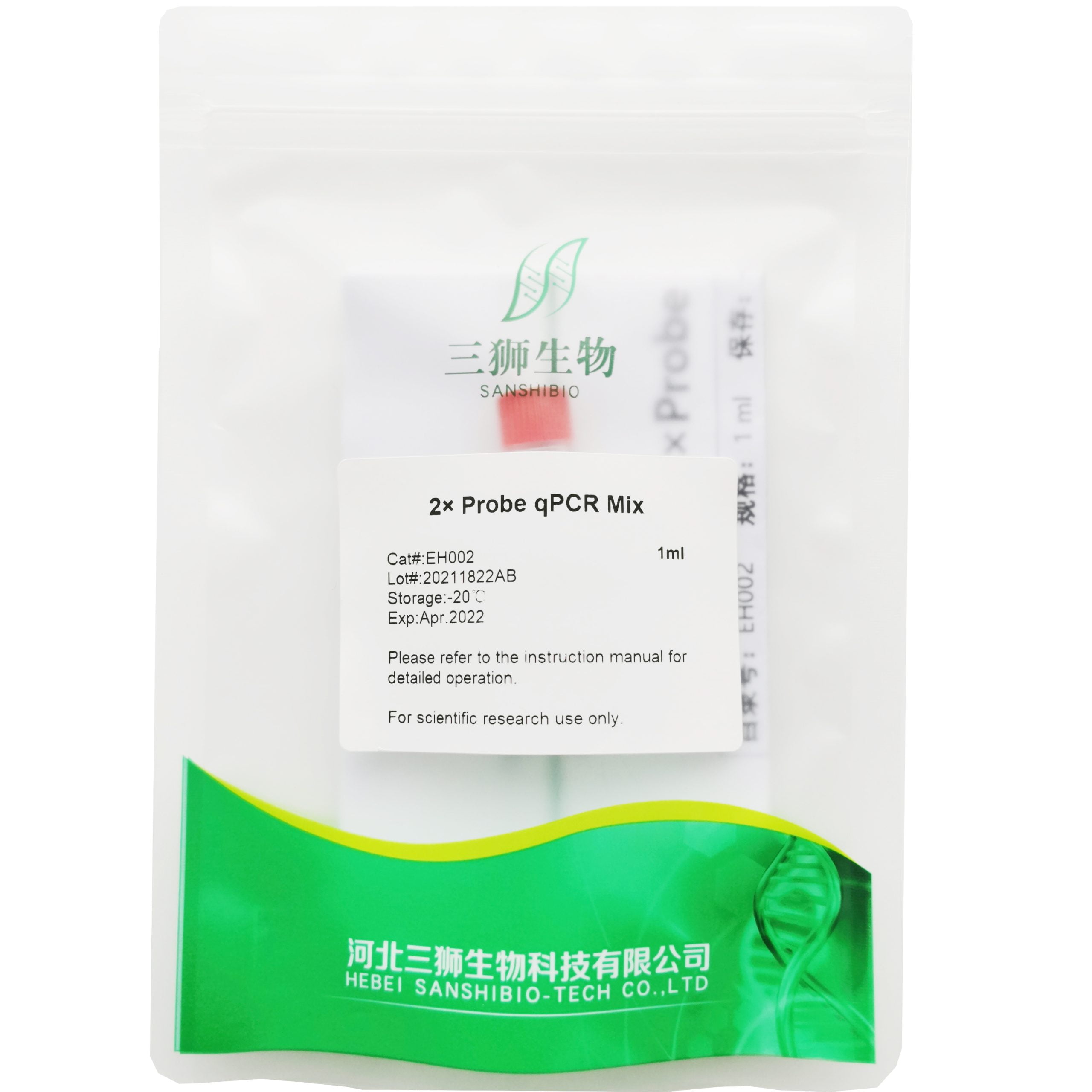
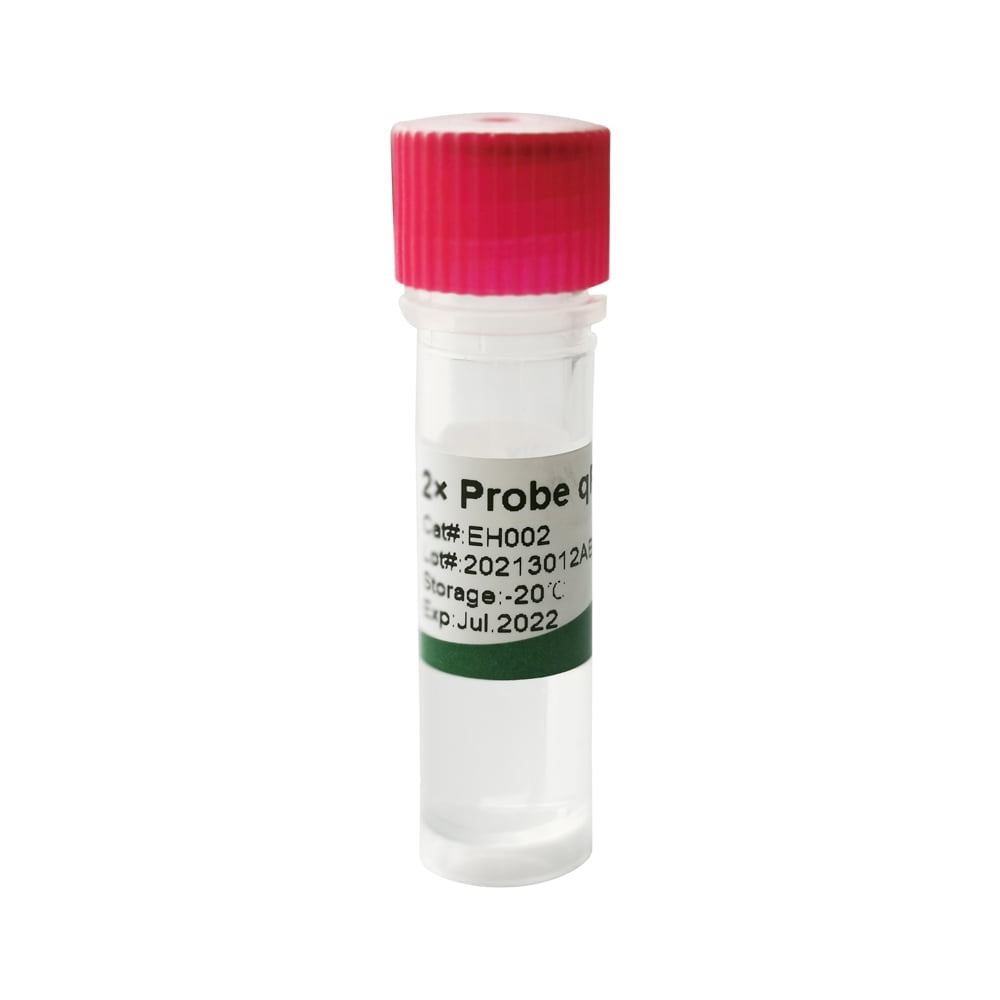
2× Mezcla de sonda qPCR
Artículo No:EH002 Especificación:1mL Storage: Conservar a -20°C
Introducción del producto:
This product is a specialized reagent for Real-Time qPCR using the probe method. It contains an antibody-blocked hot-start enzyme that effectively suppresses non-specific amplification caused by primer misannealing or primer dimer formation at low temperatures, thereby enhancing the specificity of the amplification reaction. This product exhibits high amplification efficiency and detection sensitivity, allowing for the generation of a robust standard curve across a broad quantification range, permitiendo una cuantificación precisa. Además, it is compatible with various fluorescence quantitative PCR instrumentos, incluidos los de Applied Biosystems, Eppendorf, Bio-Rad, roche, y otras marcas nacionales.
Contenido del producto:
| Componentes | EH002-02 |
| 2× Mezcla de sonda qPCR | 1mililitros |
Nota:ROX Reference Dye can be obtained separately or through the manufacturer to correct inter-well fluorescence signal discrepancies in certain company’s Real-Time PCR amplifiers. ROX Reference Dye I is suitable for ABI PRISM 7000/7700/7300/7900HT and Step One Plus Real-Time PCR Systems, etc.. ROX Reference Dye II is suitable for 7500 Sistema de PCR en tiempo real, 7500 Sistema de PCR rápido en tiempo real, Stratagene Mx3000P, Mx3005p, y MX4000, etc.. The final concentration of ROX Reference Dye I and II is 1×. Real-time fluorescence quantitative PCR amplifiers such as LightCycler, Termociclador Dice Sistema en tiempo real II, y el sistema Smart Cycler no requieren el uso de tinte de referencia ROX.
Almacenamiento:
Conservar a -20°C, con una vida útil mínima de 12 meses.
Definición de actividad:
Uso del ADN del esperma mahi-mahi activado como plantilla/cebador, la actividad se define como 1 unidad (Ud.) de material insoluble en ácido incorporado, tomando 10 nmol de nucleótidos dentro 30 minutos a 74°C.
Control de calidad:
Este producto ha sido sometido a pruebas de calidad y no tiene actividad desoxirribonucleasa endonucleasa., actividad exonucleasa desoxirribonucleasa, y contaminación por ribonucleasa. El contenido residual del ADN genómico del huésped está por debajo 10 copias.
Usos del producto:
Real-time fluorescence quantitative singleplex or multiplex (2-4 canales) qPCR (probe method) amplification of DNA or cDNA; absolute quantification qPCR.
Instrucciones de uso:
- Equilibrate the required reagents at room temperature until fully dissolved, gently mix well (no agitar), use after a brief centrifugation to prevent excessive bubble formation, and avoid repeated freeze-thaw cycles. Si se usa con frecuencia, conservar a 4°C. Prepare the PCR reaction mixture according to the components listed below (prepare the reaction mixture on an ice box):
| Reactivos | 25μLSystem Volume | Concentración final |
| 2× Mezcla de sonda qPCR | 12.5µL | 1× |
| Primer yo (10µm) | 0.5-2.5µL | 0.2-1.0µM |
| Primer II (10µm) | 0.5-2.5µL | 0.2-1.0µM |
| Sonda (10µm) | 0.25-1µL | - |
| Tinte de referencia ROX I o tinte de referencia ROX II | 0.5µL o 0,25 µL | 1× |
| Plantilla ADN | 1-5µL | - |
| Ddh2oh | Hasta 25 μl | - |
Nota:The amounts of each component in the reaction system can be adjusted according to actual requirements. Users need to decide whether to add ROX Reference Dye based on the actual model being used.
- En general, Se puede usar un método de dos pasos para la reacción; if the two-step amplification is not satisfactory, a three-step method can be used to set up the PCR reaction program.
| Método/pasos | PCR en tiempo real de dos pasos | PCR en tiempo real de tres pasos | Ciclos |
| 95℃ (Preenaturación) | 2-5mín. | 2-5mín. | 1 |
| 95℃ (Desnaturalización) | 10-20segundo | 10-20segundo | 35-45Ciclos |
| 55℃ -65 ℃ (Recocido) | 20segundo – 1min(Recoger fluorescencia) | 10-20segundo | |
| 72℃ (Extensión) | - | 20segundo – 1min(Recoger fluorescencia) |
Nota: Las condiciones de reacción se pueden ajustar y optimizar de acuerdo con los requisitos reales.
- Una vez completada la reacción, analyze the experimental results. For detailed analysis methods, refer to the PCR amplification instrument operating manual.
Precauciones:
- The concentration of the primers used can be adjusted within the range of 0.2-1.0 µM, and the DNA template can be appropriately adjusted based on its concentration.
- Choose an appropriate annealing (extensión) temperature based on the primer design. Típicamente, the Tm value of the primers is designed to be around 60°C. For primers with lower annealing temperatures or for amplifying long fragments exceeding 200 pb, Se recomienda un método de tres pasos..
- The concentration of the probe used can be optimized within the range of 0.1-0.4 µM. Conduct experiments with gradient concentrations to find the optimal combination of primers and probes. The use of probes depends on the Real Time PCR instrument, probe type, and fluorescent label type. Refer to the instrument manual or specific requirements for each fluorescent probe for adjustments.
- Use dedicated areas and pipettors before and after amplification, usar guantes, y cámbalos con frecuencia. Después de la amplificación por PCR, do not open the reaction tubes directly. Place them at 4°C or -20°C to cool sufficiently before opening to minimize the risk of PCR product contamination in the experimental environment.

Reseñas
Aún no hay reseñas.