
Introducción
This product offers a fast and reliable method to isolate RNA, incluyendo miARN, from a wide range of samples:
- Tejido
- Células
- Sangre
- Other clinical samples
The extracted RNA is suitable for various downstream applications, incluido:
- RT-PCR (Reverse Transcription PCR)
- Quantitative RT-PCR (qRT-PCR)
- Viral RNA detection
- Other RNA-based analyses
This highlights the product’s versatility and compatibility with various research needs in gene expression analysis and RNA detection.
Especificaciones
| Características | Especificaciones |
| Funciones principales | Isolation of total RNA(miRNA)from tissue, and cell using two columns and DNase plus reagent |
| Aplicaciones | RT-PCR, síntesis de ADNc, secuenciación de segunda generación |
| Productos | ARN, miARN |
| Método de purificación | Mini columna de giro |
| Tecnología de purificación | tecnología de sílice |
| método de proceso | Manual (centrifugación o vacío) |
| Tipo de ejemplo | Tejidos clínicos, células, linfocitos |
| Cantidad de muestra | Tejido: <20 mg
Células: <5 X 10⁶ |
| Producir | 2-50metrogramo |
| Volumen de elución | ≥30μl |
| Tiempo por carrera | ≤25 minutos |
Principio
- Purification Method: Silica column purification is employed in this product for effective nucleic acid extraction.
- Paraffin Removal: Buffer DPS is utilized to remove paraffin from the samples prior to the purification process.
- Sample Lysis and Digestion: The sample lysis process, coupled with proteinase K digestion, takes only 15 minutos, ensuring rapid processing.
- Incubation Conditions: Following lysis, samples are subjected to a 15-minute incubation at 80°C to facilitate optimal nucleic acid release.
- Nucleic Acid Adsorption: Transfer of the lysed samples to an adsorption column allows RNA to adsorb onto the membrane selectively, while proteins remain unadsorbed and are removed through filtration.
- Washing Step: Proteins and other impurities are washed away from the membrane to enhance the purity of the extracted RNA.
- Elución: Finalmente, RNA is eluted from the membrane using a low-salt buffer, ensuring efficient recovery of high-quality RNA.
Ventajas
- Eliminación eficiente de ADN – One-step extracción de ARN can effectively remove genomic DNA
- Alta calidad – one-step RNA extraction reagent combined with silica gel column can obtain the highest concentration
- Rápido – toda la extracción solo toma 15-25 minutos
- No tóxico – no toxic phenol-chloroform extraction is required in the extraction
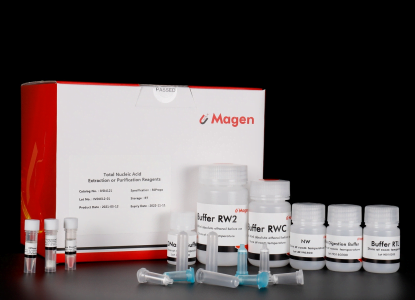
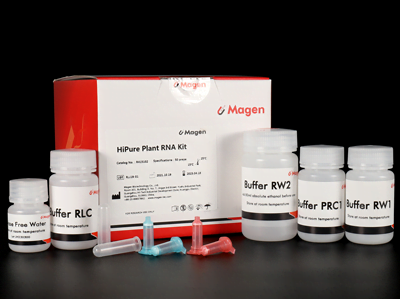
Contenido del kit
| Contenido | IVD4121 |
| Tiempos de purificación | 50 preparativos |
| Minicolumna HiPure DNA Ⅱ | 50 |
| Minicolumnas de ARN HiPure | 50 |
| 2Tubos de recolección de ml | 150 |
| Proteinasa K | 24 mg |
| Tampón de disolución de proteasa | 1.8 ml |
| ADNasa I | 600 µl |
| Tampón ADNasa | 6 ml |
| RTL del búfer | 40 ml |
| Tampón de digestión de ARN | 15 ml |
| Tampón RWC* | 20 ml |
| Búfer RW2* | 20 ml |
| Agua libre de nucleasas | 10 ml |
Almacenamiento y estabilidad
- Almacenamiento de proteinasa K: Store Proteinase K at 2–8°C upon arrival. Almacenamiento a corto plazo (hasta 8 semanas) a temperatura ambiente (15–25°C) is acceptable without affecting its performance.
- DNase I Storage: Store DNase I at -20°C. Almacenamiento a corto plazo (hasta 1 semana) a temperatura ambiente (15–25°C) no afecta su rendimiento.
- Remaining Kit Components Storage: Los componentes restantes del kit se pueden almacenar a temperatura ambiente. (15–25°C) y permanecer estable por al menos 18 meses en estas condiciones.
Reseñas
Aún no hay reseñas.